

Staff Reporter, Dhaka
Persons with disabilities in Bangladesh want to move beyond sympathy toward meaningful participation and employment in society. They called for special support for people with severe disabilities, including increased allowances, while emphasizing that persons with mild disabilities need greater access to jobs and public spaces rather than relying solely on financial support. They also stressed the importance of education, skills development, and integrated policy planning for disability inclusion.
Experts said that coordinated sector-wise budgeting and action plans are essential to achieve these goals. Government policymakers attending the discussion agreed on the need to reform disability protection laws.
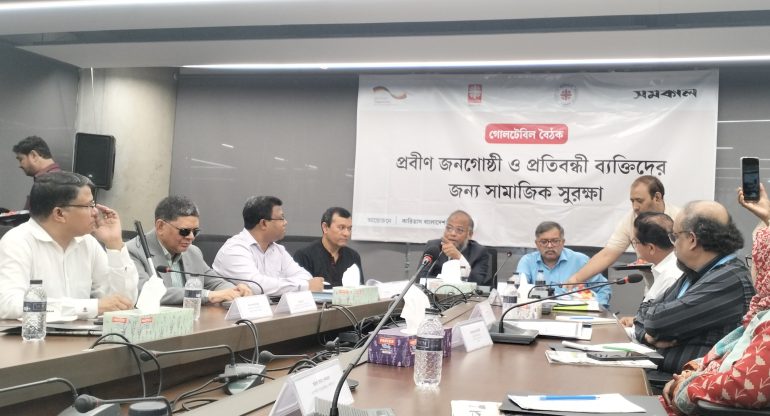
These issues emerged during a roundtable discussion titled “Social Protection for Elderly and Persons with Disabilities,” jointly organized by Caritas Bangladesh and Samakal at the Samakal office on Thursday. The event brought together persons with disabilities from marginalized communities, researchers, and policymakers. Alongside highlighting gaps in government initiatives, the discussion also addressed government plans for elderly and disabled populations, proposed increases in allowances, initiatives to distribute wheelchairs for improved mobility, and progress toward building a stadium complex for disabled athletes.
The discussion was moderated by Samakal Editor Shahed Muhammad Ali. The chief guest was Dr. Mohammad Abu Yousuf, Secretary of the Ministry of Social Welfare. Special guests included Md. Tarikul Alam and Md. Mosharraf Hossain.
Opening the discussion, Shahed Muhammad Ali said social protection for elderly and disabled people is not merely a policy issue but a test of humanity, state vision, and social values. He noted that the true measure of development lies in ensuring safe, dignified, and inclusive lives for the most vulnerable people in society.
Dr. Mohammad Abu Yousuf emphasized the importance of accurate data to ensure services for all citizens. He said the government’s resources are limited while demands are many, making competition for resources inevitable. He also highlighted the potential role of the corporate sector in supporting persons with disabilities through accessible public spaces, education, and skills training.
The Social Welfare Secretary announced that the government recently decided to increase the number of elderly allowance beneficiaries from 6.1 million to 6.2 million and raise the monthly allowance from Tk 650 to Tk 700. He also said the number of widow allowance recipients would increase from 2.9 million to 3 million next year, while disability education stipends are also set to rise.
Dr. Abu Yousuf further stated that a stadium with residential facilities for disabled athletes is being developed in Savar. He added that the government plans to create a separate list for persons with severe disabilities to ensure targeted support.
Daud Jibon Das, Executive Director of Caritas Bangladesh, said the organization currently runs two special projects supporting elderly persons and persons with disabilities. He added that Caritas has opportunities to collaborate further with the government in these areas.
The keynote paper was presented by Albert Molla, Co-founder and Executive Director of Access Bangladesh Foundation. He noted that the monthly government allowance in Bangladesh stands at Tk 900 for persons with disabilities and Tk 600 for elderly people. Comparing Bangladesh with Nepal, Sri Lanka, and India, he explained that Nepal categorizes disabilities into four levels based on severity. People in the highest “red category” receive an allowance equivalent to Tk 3,400 per month. He pointed out that Bangladesh’s allowance remains significantly lower than those of neighboring countries.
Albert Molla also highlighted that Bangladesh officially recognizes 12 categories of disabilities. However, inconsistent disability data from different agencies continues to hinder effective policymaking and implementation because survey methods vary depending on organizational objectives.
Referring to a March 2025 study by the World Bank, Molla said households with disabled family members face living costs that are 13 percent higher than average households, while families with severely disabled members experience expenses that are 30 to 35 percent higher, pushing many into poverty.
Discussing the keynote paper, Nazmul Bari, Executive Director of Centre for Disability in Development, questioned the accuracy of disability statistics in Bangladesh, noting that estimates range from 3.9 million to 20 million people. He added that some countries also provide allowances for caregivers of persons with disabilities.
Disabled participant Shahanara Khatun stressed the need for employment opportunities for educated persons with disabilities. Kaniz Fatema Asha highlighted difficulties in receiving education stipends, saying payments that should arrive monthly often take two to three months.
Nur Mohammad, Coordinator of Dream for Disability Foundation, argued that the Ministry of Social Welfare alone cannot address all disability-related issues. He said the Health Ministry should ensure healthcare, while the Transport Ministry should ensure accessible transportation services. He also remarked that not all disabled persons want allowances, suggesting that support should be increased for those who truly need it.
From Barishal, Monira Akter said even graduates with master’s degrees struggle to find jobs due to disability. She emphasized vocational training and economic self-reliance over financial allowances. Visually impaired participant Shafiuddin said the Tk 900 allowance is insufficient and called for higher education stipends.
Md. Mosharraf Hossain, Director of Social Security at the Department of Social Services, acknowledged problems in allowance distribution and explained measures being taken to resolve them. He said the number of persons with disabilities declining to receive allowances is increasing each year, although many families still depend heavily on such support.
He also stressed the need to consolidate disability-related data into a single system to avoid confusion over population statistics. According to him, a new policy integrating stipends and allowances will be implemented during the current fiscal year.
Salma Mahbub, Executive Director of Bangladesh Society for the Change and Advocacy Nexus (B-SCAN), criticized the lack of monitoring mechanisms for disability-related budget implementation. She questioned why disability allowances remain at Tk 900 when they were supposed to reach Tk 2,500 by 2000.
Ashrafun Nahar Misti, Founder Executive Director of Women with Disabilities Development Foundation, said that although persons with disabilities have strong voices, society continues to weaken their identity. Reflecting on her own educational journey, she said disabled people are not necessarily “backbenchers” and can also be top-performing students. She added that many disabled people do not want allowances; rather, they want opportunities to contribute and pay taxes like other citizens.
Md. Tarikul Alam, Managing Director of the National Foundation for the Development of Persons with Disabilities, emphasized the need to bring persons with disabilities into employment and improve their skills.
Other participants included Asim Dio from United Nations Development Programme, Ayon Debnath from Sightsavers, Chandramoni Chakma, Saidul Haque from Blind Education and Rehabilitation Development Organization, and Dewan Mahfuz-E-Mowla, along with many persons with disabilities attending the event.