

Rabiul Alam, Dhaka
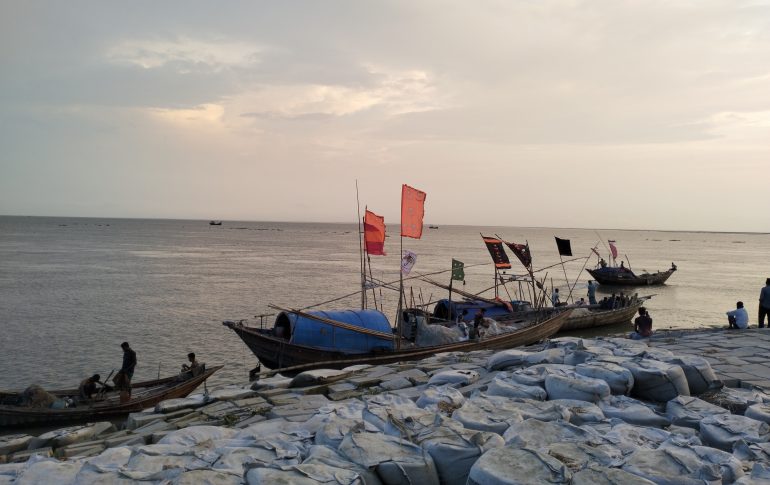
On the shifting banks of the Meghna River in Kamalnagar Upazila under Lakhimpur district memories of childhood games have faded almost as quickly as the land itself. Once vibrant courtyards where children played traditional rural games have now been swallowed by relentless river erosion, forcing families to relocate and leaving behind not just homes, but an entire cultural rhythm shaped by play, community, and river life.
For residents like Ruhul Amin, 38, and Al Amin, 29, climate-induced river erosion has not only displaced their families but also erased the spaces where generations once gathered to play and grow up together.
Ruhul Amin , a private sector employee, lost his home in 2014 when the Meghna swallowed the small settlement where he grew up in Char Jagabandhu village in the upazila.
“We had everything here, our house, our fields, and the playgrounds where we played kabaddi, danguli, and ha-du-du until sunset,” he recalled, standing near a newly formed sandbar where his home once stood. “Now there is only water and sand. My children don’t even know what those games feel like.”
Al Amin, a local businessman, who lost his home about twelve years ago, described a similar loss, not just of land, but of shared cultural life.
“There was a time when every afternoon the whole village gathered in the open fields,” he said. “We played traditional games together. Now everyone is scattered. People are busy surviving, not playing.”
The Meghna basin has long been one of Bangladesh’s most erosion-prone regions. In Kamalnagar, entire villages have been reshaped repeatedly as the river changes course, consuming farmland, homes, schools, and graveyards. But beyond the visible destruction, residents say an invisible loss has taken place: the disappearance of traditional games that once defined childhood in rural Bangladesh.
Games like kabaddi, ha-du-du, gollachut, and marbles were once deeply embedded in daily life. Children played in open courtyards, riverbanks, and village fields. These spaces were not just recreational areas but social hubs where community bonds were formed. Now, those spaces are largely gone.
“Children today don’t have safe or stable places to play,” said local schoolteacher Laizu Akter. “After erosion displaced many families, they moved into crowded areas or roadside settlements. There is no open field, no space for traditional games.”
She added that mobile phones and digital entertainment have partially replaced outdoor play, but for displaced children, even that shift reflects a deeper rupture in community life.
Ruhul Amin’s family was forced to move three times in the last ten years. Each relocation meant losing not only property but also social ties built over decades.
“When we moved, we lost our neighbors, our friends, and the children we used to play with,” he said. “Even the games we loved disappeared because there was no ground to play on.”
For Al Amin, who now works as a day laborer in a nearby growth center, survival has taken priority over cultural memory.
“When your home is taken by the river, your first thought is not about games or festivals,” he said. “It is about food, shelter, and work. But sometimes I think about those days and feel like we lost something very important.”
Experts say this erosion of cultural practices is a lesser-known consequence of climate change.
“River erosion in Bangladesh is not only a physical displacement issue; it is a cultural displacement issue,” said Dr. Farhana Rahman, a climate researcher based in Dhaka. “When communities are uprooted repeatedly, their social traditions, including traditional games, festivals, and oral histories, begin to fade.”
In the erosion-affected areas of Kamalnagar, children are growing up in temporary settlements made of tin and bamboo. Open fields are rare, and safety concerns often prevent free movement.
Twelve-year-old Sabbir Hossain, now living in a roadside cluster settlement, said she has only heard about traditional games from older relatives.
“My father tells me they used to play in big fields near the river,” she said. “We don’t have that here. We just stay near our homes or sometimes watch videos on phones.”
Local NGO workers say that while humanitarian support often focuses on shelter and food, psychosocial and cultural recovery receives far less attention.
“Children here are growing up with trauma of displacement,” said Abdul Karim, a community worker in Kamalnagar. “We try to organize small recreational activities, but without proper space, it is very difficult to revive traditional games.”
According to local estimates, hundreds of hectares of land in the Meghna basin have been lost over the past decade due to erosion. Each monsoon season brings new waves of displacement, forcing families to rebuild their lives from scratch.
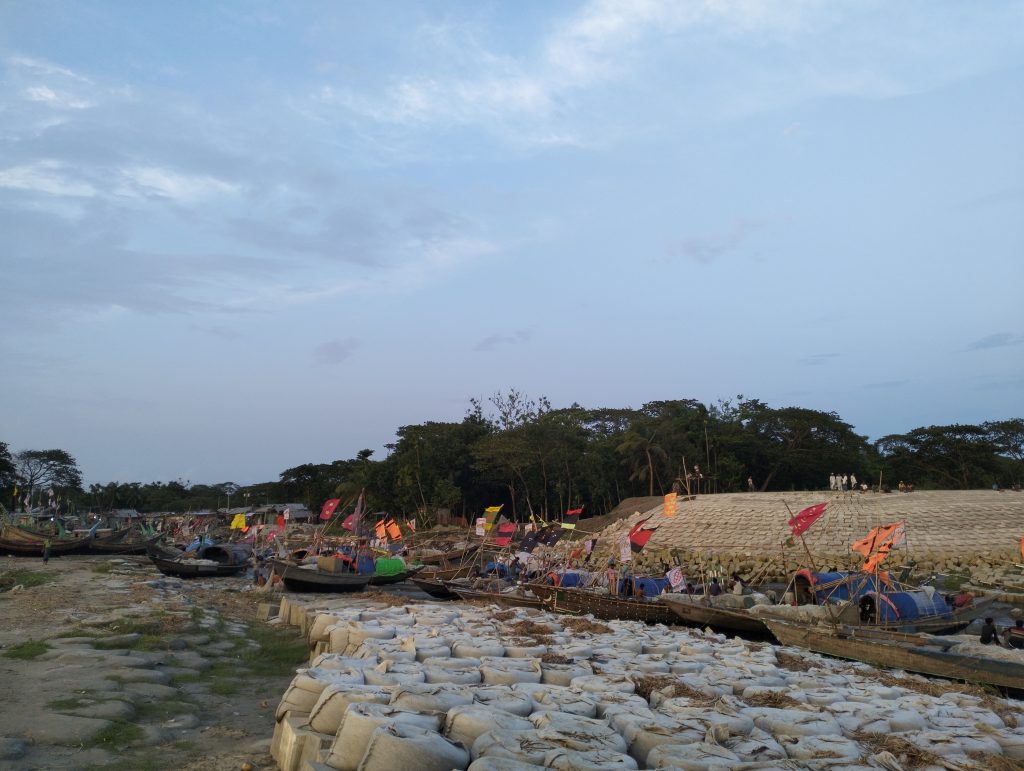
Standing on the eroded bank, Ruhul Amin pointed toward the river and said, “That was our school area. Over there was the field where we played every evening. Now even the trees are gone.” Despite repeated losses, many families remain in the area, unable to afford relocation elsewhere.
“We have nowhere else to go,” Al Amin said. “This is our home, even if the river keeps taking it.”
As dusk falls over Kamalnagar, children in nearby settlements gather in small groups, but there is little space for the expansive, energetic games once played in the open fields of the past. For older residents, these changes are difficult to accept.
“We cannot stop the river,” Ruhul Amin said quietly. “But we can remember what we lost. These games, these friendships, they were part of who we were.”